
Mid-Autumn Festival Brings Deeper Longing — Why Falun Dafa Practitioners Call Him Master IG03

In Chinese, the word Shifu (师父) combines two meanings: shi, meaning teacher, and fu, meaning father. It expresses a relationship that goes beyond ordinary instruction—one rooted in spiritual guidance, respect, gratitude, and a sense of familial closeness. In English, Falun Dafa practitioners traditionally use the word “Master” to convey this meaning.
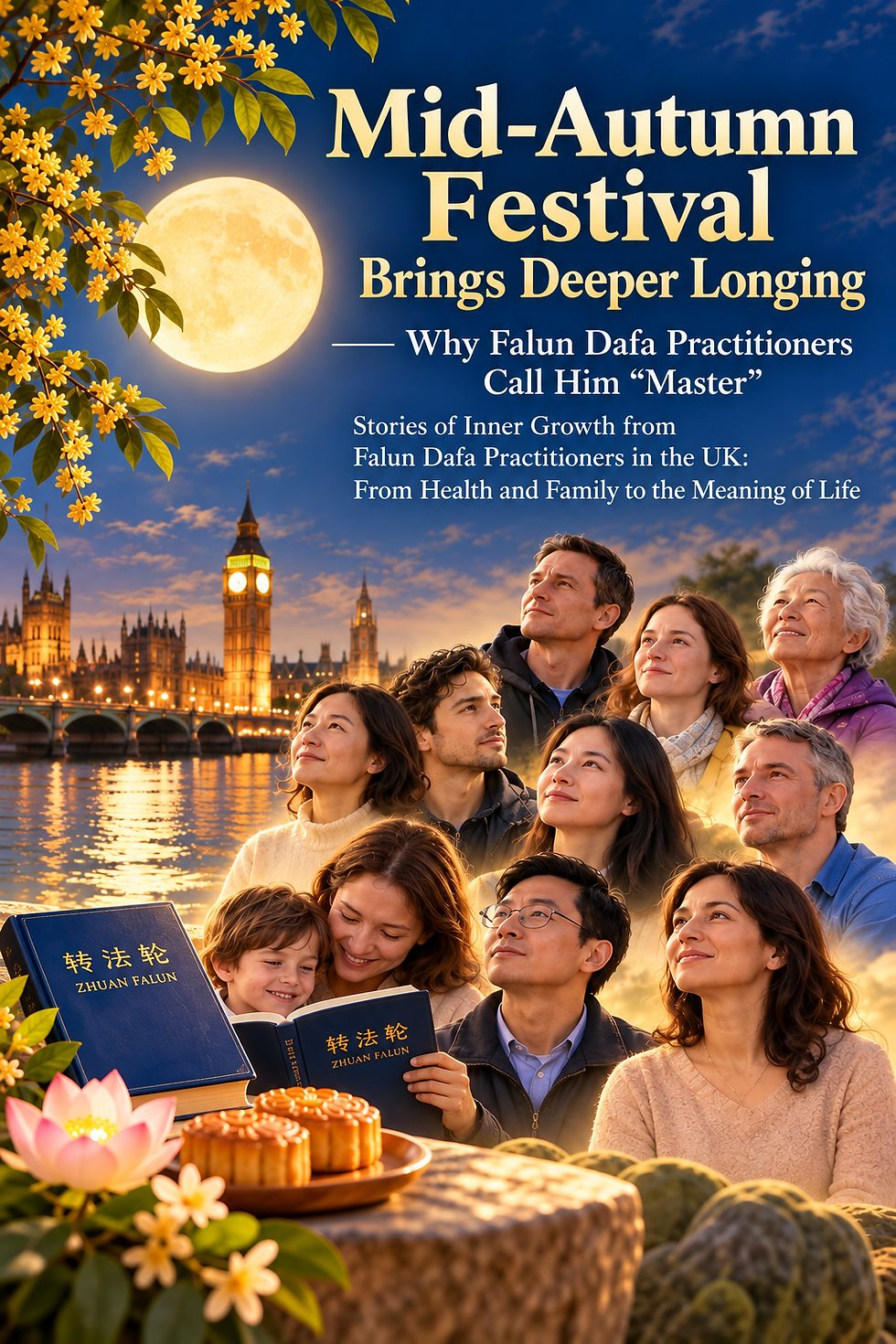
Stories of Inner Growth, Gratitude and the Search for Home
Fang Tianliang | Reflections on Civilisation · Inner Growth
Introduction
The Mid-Autumn full moon brings thoughts of parents, loved ones and home. It can also remind us of people who changed the course of our lives. Parents gave us life and families helped us through hardship. Why, then, do some people call the person who taught them a spiritual discipline “Master”, and think of him especially on a festival devoted to reunion?
In Britain, people of very different ages, professions and backgrounds—including builders, teachers, researchers, innkeepers, parents and older people—call Mr Li Hongzhi, the founder of Falun Gong, their Master. Rather than begin with an abstract definition, we can listen to their accounts.
This essay draws on published interviews and personal accounts in The Epoch Times and Minghui.org. Reported changes in health, experiences of danger and extraordinary perceptions are presented as personal testimonies, not independently established medical findings or advice to stop treatment. The central question is how these people came to understand life, respond to conflict and practise Truthfulness, Compassion and Forbearance.
1. A Life-or-Death Moment on a Ladder — Anthony Langstone

Anthony Langstone, a building decorator from Leigh in north-west England, began practising Falun Gong in 2001. He had no previous background in Eastern cultivation traditions. Through family introductions, reading and practising the exercises, he gradually felt he had found something he had long been seeking.
One incident on a job site remained particularly vivid. Working on a ladder, he mistook a live cable for an ordinary wire. An electric shock made his hand spasm, and for a time he could not pull away. High above the ground, any movement could have ended disastrously. He later recalled feeling, in his terror, as though someone were supporting him from behind, enabling him to descend the ladder.
Anthony believes his Master protected him at that moment. He said that human words could not express his gratitude. Others may not be able to verify what he felt, but the event became an unforgettable part of how he understood his own life.
Source and photograph: The Epoch Times, “Falun Dafa Helped Me Escape Death: A British Man Recounts a Miracle.”
2. “He Gave Me a Second Life” — Lu Yingling
When Lu Yingling says that her Master “gave me a second life”, she is referring first to changes she experienced after years of illness. She recalled struggling with asthma, heart discomfort, low blood pressure, nervous exhaustion and severe allergic rhinitis. After a friend gave her Zhuan Falun, she read through the night and began practising.
Yet the meaning of a “second life” also emerged in her relationships. She had long resented her younger brother and sister-in-law because she believed they had failed to care properly for their ageing parents. After taking up cultivation, she tried to let go of that resentment. She helped pay her niece’s university tuition, and after her parents died, she left the family property, possessions and savings to her brother.
Feeling better physically is welcome; choosing to help people against whom one has harboured years of bitterness may be harder still. In Lu’s story, inner growth took the form of a different choice when old grievances and material interests were at stake.
Source and photograph: The Epoch Times, report on British Falun Gong practitioners expressing gratitude at Mid-Autumn.
3. The Teacher Who Read for Twenty-Four Hours — Natalia Nutting

Natalia Nutting is a teacher who had reading difficulties and was painfully shy when she was younger. In late 2003, she noticed a change in her brother, who had previously smoked, drunk heavily and taken drugs. He had become calmer and more willing to talk with his family. He told her he had begun practising Falun Dafa.
Early in 2004 she opened Zhuan Falun and read from eight one morning until eight the next. Reading continuously for twenty-four hours was remarkable to someone who had struggled with reading. She recalled that she could not have understood everything on her first reading, yet felt she had found what she was looking for.
She says her physical condition, outlook and confidence changed. Once held back by shyness and reading difficulties, she became more comfortable communicating with others. Her experience suggests a kind of confidence rooted less in proving oneself superior than in learning to speak sincerely and treat others well.
Source and photograph: Minghui.org, report on UK practitioners celebrating World Falun Dafa Day.
4. “I Have Found Home” — Wang Shuqin, Aged Eighty
Wang Shuqin was eighty when she travelled from China to Britain in 2016. Because of high blood pressure and leg pain, she needed wheelchair assistance at the airport and had taken blood-pressure medication for many years. Encouraged by her daughter, she began the exercises. At first she was so weak that she placed a stool behind her in case she could not remain standing. Later she felt stronger.
In an interview she said she had stopped taking her long-term medication and believed her health had improved. This is her personal account, not a recommendation to stop prescribed medicine; treatment changes should be discussed with a clinician.
What connects her story most closely with Mid-Autumn is a recurring dream. In China, she often dreamed that she had gone out and could no longer find her way home. After she began practising in Britain, the dream stopped. “Now that I practise Falun Gong, I have found home,” she said. Geographically she was farther from her birthplace, yet she spoke of finding a home in a deeper sense.
Source and photograph: Minghui.org, “Finding the Way Home Through Dafa in Old Age.”
5. “Without Dafa, I Would Not Be Alive Today” — Lily
A 2025 report introduced two new practitioners in Britain.

On the surface, Racheal’s life was calm, but she felt something was missing. She had long pondered the purpose of life, differences in people’s destinies and what happens after death. Books, philosophy and religion had not given her a satisfactory answer. Invited by a friend to a reading group, she began Zhuan Falun and found a framework within which to continue exploring those questions.

Lily, originally from Vietnam, had run a beauty and nail salon in London’s West End. She described years of serious asthma, insomnia, dry eyes and a pituitary tumour, and a long search for treatment. Around the end of 2015, a friend gave her Zhuan Falun. After she began studying and practising, she reported changes in her sleep and health, and interpreted two later severe asthma episodes as turning points in her life.
One woman was asking why she was alive; the other wondered whether she could continue living well. “Falun Dafa gave me a second life. Without Dafa, I would not be alive today,” Lily said. For them, learning a set of exercises and rethinking an entire life were not separate experiences.
Source and photograph: Minghui.org, “Zhuan Falun — A Remarkable Book That Changed Lives.”
6. From the Brink of Divorce to a Warm Home — Nina
Nina, a mother of two, recalled that conflict with her husband had brought their marriage close to divorce. In family arguments, each person can usually list what the other has done wrong; asking what one might change oneself is much harder.
After beginning cultivation, she tried to measure her own conduct against Truthfulness, Compassion and Forbearance. Instead of asking only, “Why does he treat me like this?” she began asking, “What have I failed to do well?” She tried to understand her husband and be more patient with the children rather than waiting for him to change first. She says he gradually changed too, and warmth returned to their home.
The same report featured Onur, a British-born computer designer of Turkish heritage. He had read widely on spiritual and religious subjects in search of an understanding of life and the universe. He says cultivation made him calmer and more compassionate, and less preoccupied with competition and material gain. His story and Nina’s both move from “What can I get?” towards “How should I treat others?”
Source and photograph: Minghui.org, report on Western Falun Dafa practitioners in Britain expressing gratitude to Master.
7. What Is Life For? — Peter

Peter runs a family guesthouse in Cardiff, Wales. Unlike some interviewees, he was not driven to cultivation by a major illness or family crisis. Life appeared to be going on normally, yet he felt that something essential was missing and could not say exactly what it was.
After he began practising, he described life as “complete and fulfilling”. The greatest change, he felt, was learning to think less exclusively about himself. Where he once asked, “What will I get out of this?”, he began paying more attention to others and appreciating the people and surroundings in his life.
His experience raises a question that material success alone cannot settle: someone can have a reasonably stable life and still wonder why they are here. If the missing piece is not material, more possessions may never supply it.
Source and photograph: Minghui.org, New Year expressions of gratitude from across the British Isles.
8. A Guiding Light for an AI Researcher — Yang Xiaozhan

Source and photograph: The Epoch Times, report on young professionals in Britain celebrating Falun Dafa Day.
Yang Xiaozhan earned a doctorate in artificial intelligence at King’s College London and went on to work in research at a British technology company. When discussing cultivation, he often speaks in the language of a researcher rather than in dramatic terms.
He explained that when studying a problem, one can become so absorbed in details that the larger picture disappears. Cultivation taught him to step back and look more broadly. As his anxiety about status and results eased, he found it easier to focus on the research itself. The same habit of stepping back, he said, also helped in personal conflicts.
In the same group of interviews, Zhang Zhe described learning to “look within”. Formerly impatient, she tended to blame classmates when conflicts arose. By examining what she could change herself, she found relationships improving. Tang Yuan, meanwhile, moved from resenting her mother’s strictness to feeling gratitude for the life her mother had given her. Their accounts approach one lesson from three directions: before trying to change the world, consider changing yourself.
9. A Family of Three: “The Chance to Become Good People”
Trevor is a secondary-school teacher and his wife Kat works in media editing. They live in Devon in south-west England. The couple began practising Falun Gong in 2004, and their son Tristan grew up practising alongside them.
Kat recalled that, like many people, they had once followed the currents of society without stopping to ask what a truly right path in life might be. After encountering Falun Gong, the family began to examine everyday words and actions through Truthfulness, Compassion and Forbearance. “We are very grateful to Master for giving us the opportunity to cultivate, the opportunity to become good people,” she said.
There is no dramatic accident or near-collapse in this account. That is precisely why it matters. Inner growth is tested in how one speaks each day, responds to unfairness, lives with a partner’s imperfections and raises children. Becoming a good person sounds ordinary, but it can be the work of a lifetime.

Source and photograph: Minghui.org, UK practitioners celebrating World Falun Dafa Day and their Master’s birthday.
10. Simon: After Years of Trying to Quit, He “Just Stopped”
Simon, a mental-health training consultant from Scotland, attended a free Falun Gong exercise class in Edinburgh in 2001. At first he simply found the movements easy to learn and felt comfortable afterwards. Several months later he attended an experience-sharing conference in Manchester, and something unexpected happened after he returned home.
He had smoked and drunk alcohol for years and repeatedly failed to stop smoking. This time, he says, he gave up both habits naturally. He described it as “turning a new page in life”. Looking back more than twenty years later, he regards the deeper change as becoming calmer and more resolute when facing difficulties.
“Falun Dafa truly changed my life,” he said. For him, it was not only a matter of leaving two habits behind but of reassessing what mattered.
Source and photograph: Minghui.org, “British Professional: Rediscovering My True Self in Troubled Times.”
11. Pauline: What Sustains a Person Through Hardship?
Pauline, a painter and media worker, encountered Falun Gong in 2008 and began practising the following year. Life remained demanding. After her partner suffered a stroke, she carried a long-term burden of caring for her family and children.
She said she used to be quick-tempered and filled with anger and resentment. Cultivation taught her to restrain herself in conflicts, examine her own conduct and consider others’ perspectives. Her responsibilities did not vanish, but her way of bearing them changed.
People sometimes imagine salvation as the removal of every outward difficulty. Pauline’s experience suggests another meaning: hardship may remain, yet a person need not be crushed by it; others may not change as one wishes, yet one can still choose kindness. “I am deeply grateful to Master,” she has said.
Source and photograph: Minghui.org, “British Professional: Rediscovering My True Self in Troubled Times.”
12. Carina: Bringing Faith into Everyday Life
Carina Depelean, originally from Moldova, later worked in property-related business in Britain. She had been a Christian but felt she still lacked spiritual guidance she could consistently put into practice in daily life. After encountering Falun Gong, she began reading its teachings and doing the exercises.
She says she gave up smoking and drinking and became calmer, more compassionate and more patient. In the past she became angry easily and often felt unfairly treated. Later she reminded herself to consider others first. Her mother and sister noticed the difference, and arguments at home became less frequent.
Her account is not a competition between religions. It is about her search for a discipline that reaches beyond special occasions and shapes ordinary choices, temper and family relationships.

Carina Depelean,the middle lady in yellow T shirt. Source and photograph: Minghui.org, practitioners of different ethnic backgrounds discussing benefits of cultivation.
13. Huang Shishun: After Three Years of Isolation, “I Sing Every Day”
Huang Shishun was born in Malaysia and came to Britain in 2004. He earned a master’s degree in computing, studied English literature and later worked in London. From the outside he was educated, employed and married, yet he said he did not really know what he should do with his life.
At one point he entered a prolonged low period and withdrew from the world. In a 2019 interview, he described encountering Falun Dafa by saying, “I felt that Master had lifted me out.” After several months of studying and practising, he began making phone calls again, moved out and gradually emerged from roughly three years of isolation.
He also began re-evaluating his drinking, smoking and relationships. His most vivid remark was simple: “I just feel happy. I sing every day.” For someone who had shut himself away, reconnecting with the world felt like waking from a dream.

Source and photograph: Minghui.org, “Practising Falun Dafa Awakened Me from a Dream.”
14. Colleen: Learning to Step Beyond Fear
Colleen was approaching seventy when she spoke at a 2024 UK Falun Dafa experience-sharing conference. She said she had been diagnosed with Lyme disease and had been told by a specialist that recovery was unlikely. She reported that after several months of cultivation she stopped medication and her symptoms disappeared. These are her personal claims, not independently verified clinical outcomes or guidance for other patients.
She also described a less visible difficulty: severe anxiety. She was so afraid of meeting people that she struggled even to approach a group exercise site. When she finally pushed herself to walk over, she found the atmosphere peaceful and her anxiety eased.
Illness may be visible, but persistent fear and avoidance can also shrink a person’s world. Colleen’s story is about moving from “I cannot go over there” to taking that first step. Many changes happen through small acts of courage rather than in a single dramatic moment.

Colleen is speaching. Source and photograph: Minghui.org, 2024 UK Falun Dafa conference report featuring Colleen.
15. Alberto: Choosing a New Way of Life at Sixty-Nine
Alberto, an Italian man living near Wimbledon in London, had practised yoga since his twenties and explored different approaches to wellbeing. In his sixties, he noticed free Falun Gong instruction at Wimbledon Library. He joined group exercises, later practised at home daily and read Zhuan Falun with other practitioners.
He says his willpower, patience and mental steadiness improved, and he found it easier to concentrate. He described the five exercises together as “a journey”.
More important to him was a change in attitude: he became more positive, happier and more relaxed, and better able to accept what happened. He also noticed changes in the way long-standing colleagues treated him. At sixty-nine, a person can still choose a different way of living.

On August 18, 2018, after the Falun Gong practice class at Wimbledon Library, Falun Gong practitioners Wendy (right), Scott (left), and Alberto (center) shared their experiences of practicing the exercises. Source and photograph: Minghui.org, “A Source of Life in the Wimbledon Community.”
What Do These Stories Have in Common?
It would be easy to read these accounts only as stories of illness, recovered habits or improved relationships. Yet the recurring theme is the standard by which people began judging their own conduct. Lu Yingling tried to release resentment; Nina stopped making her husband’s change a precondition for her own; Zhang Zhe learned to look within; Peter began to consider others. They describe cultivation not simply as obtaining benefits, but as learning to become better people.
Why “Master”, Rather Than Simply “Teacher”?
In Chinese culture, a teacher commonly imparts knowledge or a skill. A master in a traditional cultivation discipline also guides a person along a path of self-cultivation. The Chinese word shifu carries associations of both instruction and profound care. The saying “A teacher for a day, a father for life” expresses gratitude for guidance; it does not mean replacing one’s parents.
Falun Gong practitioners use “Master” both within that cultural tradition and in light of their own experiences. They believe Mr Li Hongzhi taught them not only five sets of exercises but principles concerning moral character, self-cultivation and the meaning of life. Thus when Anthony speaks of protection, Lu of a second life, Wang of finding home and Kat of the opportunity to become good people, they are speaking of changes they consider much larger than acquiring a skill.
From Physical Benefits to Moral Choices
Health changes are often the first thing readers notice. Yet many interviewees place greater emphasis on learning how to behave. Lu Yingling made peace with family members, Nina changed the way she approached her husband, and Kat’s family tried to live by a simple ambition: becoming good people. For some, health concerns opened the door to cultivation; for them, changes in character and moral choice became the enduring theme.
Looking Within, Especially When We Feel Right
In conflict it is easy to list what someone else has done wrong. “Looking within” asks a more difficult question: even when the other person is at fault, is there something I could do better? This does not mean denying facts, accepting abuse or abandoning boundaries. It means refusing to make one’s own moral growth entirely dependent on someone else changing first. Nina and Zhang Zhe describe how such reflection opened space for better relationships.
Finding Home Is More Than Finding an Address
Wang Shuqin left China at eighty and moved farther from the place where she had lived most of her life, yet said that through cultivation she had “found home”. Peter, without an obvious external crisis, continued to search for a sense of belonging. Mid-Autumn speaks of returning to loved ones, but it also invites a deeper question: where do we come from, and where are we ultimately going?
Gratitude to a Master and Gratitude to Parents
Honouring a master need not diminish love for parents. Lu Yingling reconsidered her relationship with her brother; Tang Yuan came to appreciate her mother; Nina worked to repair her marriage. Chinese tradition values both the duty to parents and gratitude to those who teach and guide. If a spiritual practice makes someone kinder, those closest to that person ought to be among the first to feel it.
Beyond the Extraordinary: The Choices of Daily Life
Readers may differ on claims of recovery or protection in moments of danger. Personal testimony is not the same as medical research, but it need not be stripped of the meaning the speaker gives it. Even without settling extraordinary claims, the ordinary questions remain: can we be less resentful, more patient, more restrained in competition, and more considerate towards those around us?
From Receiving to Giving
Many people first turn towards spiritual practice because they are ill, troubled at home or searching for meaning. Later, some begin to ask not only what they can gain, but what they can offer others. One fewer argument at home, a little less rivalry at work, more patience with a vulnerable person—inner growth has value when other people can feel its kindness.
Why Mid-Autumn Deepens Their Sense of Kinship
The deepest meaning of Mid-Autumn is not the mooncake but the longing to return. The full moon reminds people of home, even when they cannot travel there. For Falun Gong practitioners, that idea also reaches into their understanding of life beyond a single lifetime.
In April 2023, Mr Li Hongzhi published “Why the Creator Seeks to Save All Life”, discussing, within Falun Gong’s spiritual worldview, ancient connections among living beings and the Creator. Readers need not share that worldview to understand that it shapes how practitioners speak of kinship. They believe their relationship with their Master is more than a chance encounter in this lifetime.
This is why people from different countries and walks of life can speak with the same gratitude. What they share is not nationality, occupation or upbringing, but the conviction that the same teachings changed their lives.
Conclusion: The Gratitude That Changes the Direction of a Life
Throughout life, we meet people who help us find work, lend us money or stand beside us in danger. There is another kind of help that is harder to measure: helping a person let go of bitterness, show kindness to family, find direction or learn to examine themselves in conflict.
Anthony remembers the moment on the ladder. Lu Yingling remembers learning to treat relatives with kindness. Natalia remembers twenty-four hours spent reading. Wang Shuqin remembers the dream in which she could never find home—and how it ceased. Nina remembers a marriage nearly lost; Peter remembers the emptiness he could not name.
When the Mid-Autumn moon rises, they think of their Master. Not because a festival instructs them whom to remember, but because gratitude naturally turns towards those they believe they must never forget.
For many, “missing loved ones all the more during festivals” means parents, spouses, children and home. For these practitioners it also includes what they believe is a sacred bond extending beyond this life. Readers may or may not share their faith. Their stories nevertheless invite a question: what kind of kindness makes someone say, even decades later, “Thank you. I have not forgotten”?
Editorial Source Index
The source references below are translated from the Chinese draft and have not been independently verified against the original articles.
大纪元:《法轮大法帮我死里逃生》英国人见证奇迹
大纪元:英国法轮功学员中秋感恩——无限敬仰李洪志大师
明慧网:英国学员游行集会庆祝世界法轮大法日
明慧网:耄耋之年修大法 找到回家的路
明慧网:《转法轮》——一本改变生命的奇书
明慧网:英国西人学员感恩法轮大法师父
明慧网:新年之际来自英伦三岛的感恩
大纪元:庆祝大法日 一群英国年轻精英感恩李洪志大师
明慧网:英国学员恭祝师尊华诞 庆世界法轮大法日
明慧网:英国专业人士——乱世中找回真正自我
明慧网:不同族裔学员谈在法轮大法中修炼身心受益
明慧网:修炼法轮大法让我从梦中醒来
明慧网:英国温布尔登社区里的“生命之源”
明慧网:2024英国法会报道(Colleen)
李洪志:《为什么要救度众生》


Comments