
<A Little Streak of Red — A Complete Guide to Bleeding Gums, East and West>HW07

A little pink in the sink when you brush — do you just rinse it away? Follow five people — a builder who lives on energy drinks, a retired teacher whose teeth seem to be getting longer, a mum-to-be with bleeding gums, a shop owner whose diabetes and gums affect each other, and a young woman whose gums bleed at a touch after months of dieting — to understand how bleeding gums turn into gum disease, who is most at risk, how to care for your gums at home, how Chinese medicine sees it, and when to see a dentist. Includes a special appendix on UNITEIN gum-care toothpaste from Korea.
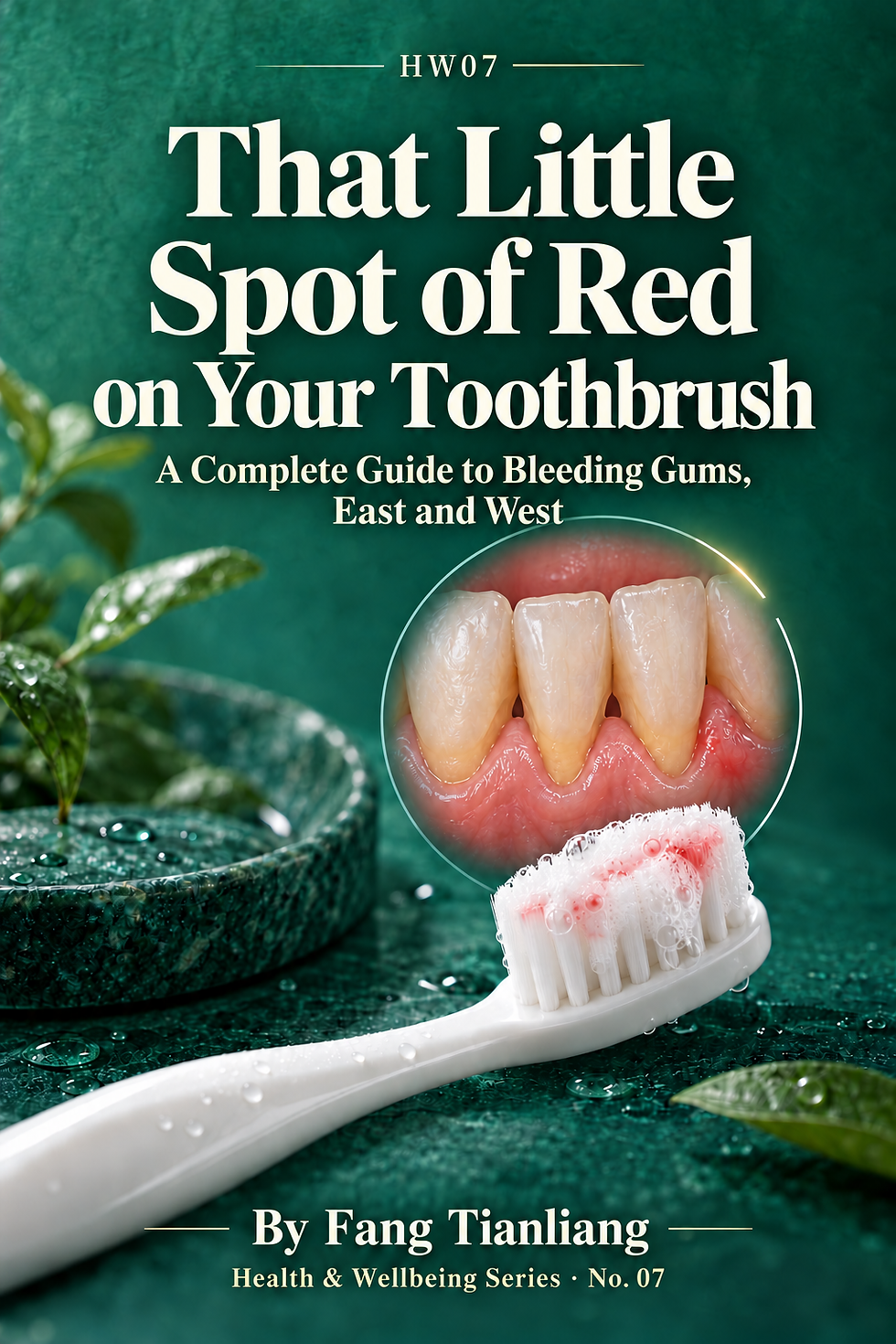
A Little Streak of Red On Toothbrush
A Complete Guide to Bleeding Gums, East and West
Reading the Signal · Saving Your Teeth · Acting Early
By Fang Tian Liang
Health & Wellbeing No 07
Foreword: A Warning Light That's Been On for Ten Years
You're brushing your teeth in the morning. You spit into the sink, and there, in the foam, is a little streak of pink. Most people rinse, mutter "must have brushed too hard", and head off to work.
Bleeding gums are one of the most common body signals in the world, and one of the most ignored. Among adults, bleeding gums and gum problems are remarkably common — this is not a rare complaint. And yet plenty of people live with it for ten or twenty years without ever getting it checked, and rarely mention it to anyone.
It's a bit like that little amber light on a car dashboard: it doesn't beep, it doesn't flash, and the car still drives perfectly well. So people keep driving — until the day they bite into an apple and feel a tooth give, just slightly.
This little book sets out to answer a few questions. Why are bleeding gums so easy to ignore? How do they slowly turn into gum disease? Why do some people get worse quickly while others barely change? What is gum treatment actually trying to do? How does Traditional Chinese Medicine (TCM) understand the link between the teeth and the rest of the body? And, most importantly — what can you start doing tonight, when you brush your teeth?
Chapter One: How Does a Tooth Stay Standing?
A tooth isn't simply stuck into the bone. It's held in place by layers: on the outside, the gum; between the root and the bone, a thin cushioning layer called the periodontal ligament; and underneath it all, the load-bearing jawbone.
Think of the tooth as a tree. The bone is the soil, the ligament is the cushioning roots, and the gum is the little fence around the base. Break the fence, and rain washes into the soil. Lose the soil, and the tree starts to wobble.
The culprit: plaque. Many people think plaque is just leftover food. It isn't. Plaque is a city built by bacteria on the surface of your teeth — a biofilm, complete with housing, roads and defences — and a tiny speck can hold hundreds of millions of bacteria. It rebuilds itself every day, which is why it needs clearing every day.
Plaque, upgraded: tartar. If plaque isn't removed, it soaks up minerals from saliva and slowly hardens into tartar (calculus) — rather like limescale in a kettle. A toothbrush can't shift limescale, and it can't shift tartar either. Its rough surface then collects even more plaque, and the cycle feeds itself. That's why even the most careful brusher needs a professional clean from time to time.
Did you know? You can actually see your plaque. Pharmacies sell plaque disclosing tablets: chew one, and the plaque turns bright pink or purple. Most people get a shock the first time — the spots they thought were cleanest turn out to be covered. It's an instant truth-teller, and the best family brushing game there is.
Chapter Two: From Bleeding Gums to a Lost Tooth — Four Steps and Twenty Years
Step one: gingivitis. Plaque irritates the gums, making them red, swollen and prone to bleeding. But the inflammation stays in the gum; the bone hasn't been touched — only the fence is affected. And here's the crucial thing: it's reversible. Clear the plaque and improve your cleaning, and the gums usually look noticeably better within a week or two.
Step two: periodontitis. If the inflammation isn't brought under control, it travels down the root and starts breaking down the ligament and the bone, opening up an abnormal gap between gum and tooth — a periodontal pocket. It's dark and low in oxygen in there, which is exactly what anaerobic bacteria love, so the pocket deepens and the cycle continues. Unlike gingivitis, support that has been lost at this stage usually won't come back just because you brush better. But proper treatment can control the inflammation and slow or stabilise the disease, and in some suitable cases regenerative treatment can restore part of the lost support.
Step three: loose teeth and receding gums. As the bone keeps shrinking, the foundations weaken. Teeth start to move and chewing feels less steady. The gums pull back, the roots are exposed, cold drinks make teeth twinge, and teeth start to look "longer" than they used to.
Step four: losing a tooth. At the late stage, a tooth may fall out on its own, or need to be taken out.
The whole journey can take ten or twenty years, often without pain that matches the damage being done. That's why gum disease is called a "silent disease". Silent doesn't mean it never hurts, though: a flare-up or a gum abscess can be painful enough to keep you awake. The pain just doesn't necessarily come early.
Why can it be ignored for ten years?
● It barely hurts. Early on, there's just the odd bit of blood, easily blamed on brushing too hard.
● It's slow. Changes happen over years — a low-level, long-running signal that everyday life easily drowns out.
● We avoid it. Worries about cost, discomfort, or simply being told off by the dentist.
The thirty-second check
① Do your gums bleed when you brush, or bite into an apple? ② Do your teeth look "longer" than they used to? ③ Is food getting stuck between your teeth more often? ④ Do you have bad breath? ⑤ Does any tooth feel loose, or seem to have moved?
Two or more yeses? Book a gum check with your dentist this month.
Chapter Three: Why Do Some People Get Worse Faster?
Plaque is where it starts, but how far and how fast the disease goes isn't just about how well you brush. These "accomplices" all affect the risk and the pace:
● Smoking — the number one accomplice. It speeds up damage and also hides the symptoms (see the box below).
● Diabetes — and the link runs both ways. Poorly controlled blood sugar makes gum inflammation more likely; gum inflammation makes blood sugar harder to control.
● Genes and age — some people are simply more prone to inflammation.
● Pregnancy hormones — many mums-to-be develop "pregnancy gingivitis".
● Certain medicines — some blood-pressure tablets, epilepsy medicines and immunosuppressants can cause gum overgrowth, and many medicines cause a dry mouth, which weakens saliva's protection.
● Stress and long-term cleaning habits — under stress, people tend to brush more hastily, sleep worse and smoke more.
This is why modern gum care puts so much weight on risk assessment. Your dentist doesn't just look at one tooth; they ask whether you smoke, how your blood sugar is, and what medicines you take. In other words, modern medicine never looks only at that one small corner of the mouth — the gums and the rest of the body are linked in complex, two-way ways.
The muted alarm: Gary's story
Gary is fifty-five and has smoked for thirty years. He was always rather proud of it: "My gums never bleed." Then one day he noticed the gap between his front teeth was getting wider. His dentist found deep pockets.
Nicotine narrows the blood vessels in the gums, putting the bleeding alarm on mute — not because the gums are healthier, but because the alarm has been gagged. Three weeks after Gary quit, his gums started bleeding when he brushed, and he panicked. His dentist reassured him: that's often the blood supply recovering. The alarm has simply switched back on.
Chapter Four: How Does Chinese Medicine See the Teeth and Gums?
If Western medicine mostly understands gum disease through local tissue structure and whole-body risk factors, Traditional Chinese Medicine offers a different framework for observation.
TCM has a saying: "the teeth are the surplus of the bones" — the teeth are seen as an extension of the skeleton. And since "the kidneys govern the bones", loose teeth or early tooth loss are often linked to the state of the "kidneys" in TCM thinking. TCM also holds that "the gums are connected with the yangming channel", linking the gums with the stomach and spleen. So repeated bleeding gums may be understood, in TCM pattern-diagnosis, as the outward sign of different underlying patterns — such as "stomach fire rising", "kidney yin deficiency with deficiency heat", or a weak spleen that "fails to hold the blood".
It's important to be clear: TCM's "kidney", "stomach fire", "yin deficiency" and "spleen failing to hold the blood" are a theoretical vocabulary for organising clusters of symptoms. They can't be equated with the kidney as an organ, the stomach, or any single inflammation marker in modern medicine. Which pattern applies is for a qualified practitioner to judge, based on the tongue, the pulse and the whole picture — not from bleeding alone.
With that in mind, the five stories that follow will make more sense.
Chapter Five: Five People, One Streak of Red
The people in these five stories are fictional. They're here to show how the same bleeding gums can point to very different things going on in the body — not as a diagnostic tool for any reader. Each story presents both "how TCM would frame it" and "what modern medicine would check first". Two maps, describing the same person.
How to use the toolkits in this chapter
Each story ends with a toolkit on three shelves: the pharmacy shelf (over-the-counter products), the kitchen shelf (everyday food), and the TCM cabinet (Chinese patent medicines). A few ground rules first:
1. The dentist always comes first. Nothing on any shelf replaces a gum check and a professional clean. Only a dentist or hygienist can remove tartar.
2. Brand names are examples, not endorsements. These are products you'll find in UK pharmacies; own-brand versions with the same active ingredient work just as well. Read the leaflet, and ask the pharmacist first if you're pregnant, breastfeeding, taking other medicines or have a long-term condition.
3. Chinese patent medicines must match the pattern — and they're only a support. Names are given in pinyin and Chinese characters so you can recognise them. The wrong one for your pattern can make things worse. In the UK, only a small number of herbal products carry the MHRA's THR (Traditional Herbal Registration) mark, so the safest route is through a registered TCM practitioner after a proper consultation. Keep courses short (usually no more than 1–2 weeks). If you're pregnant, if it's for a child, if you have diabetes, or if you take blood thinners (such as warfarin), diabetes or blood-pressure medicines, always check with your doctor first.
Story One: "Stomach Fire Rising" — The Builder Who Lives on Energy Drinks
Rob is forty and works as a builder. He gets through three energy drinks a day, lunch is often fried chicken and cola, and weekends mean barbecues and beer. His gums are red, swollen and shiny, bleed bright red at the lightest touch, his breath is strong, he's always thirsty for something cold, and he's often constipated.
How TCM would frame it: a red tongue with a yellow coating, thirst for cold drinks, red swollen bleeding gums, bad breath and constipation — TCM calls this "stomach fire rising". The stomach channel runs into the gums; a long-term diet of spicy, greasy food and sugary drinks builds up heat in the stomach, which rises along the channel and shows up in the gums.
What modern medicine would check first: red, swollen, bleeding gums call for a gum assessment, to see whether this is gingivitis or has already become periodontitis. Large amounts of sugary drinks feed plaque, and acidic drinks erode tooth enamel. Constant thirst is also worth a blood sugar check.
Rob went for a clean first, and his dentist found early pockets. He cut down from three energy drinks a day to one, then switched to sparkling water, and learned the Bass brushing technique. At his check-up two months later, the pockets had become shallower. As Rob put it: "Turns out the fire in my mouth was one I was pouring petrol on every day."
Rob's Toolkit: Putting Out the Fire
The pharmacy shelf (OTC)
● A gum-care toothpaste — such as Parodontax or Corsodyl Daily. Twice a day for two minutes, then spit, don't rinse.
● Chlorhexidine 0.2% mouthwash — such as Corsodyl Mouthwash — as a short course while the gums are inflamed (follow the pack; usually no more than a few weeks), because long-term use stains teeth. Wait at least 30 minutes after brushing, as toothpaste ingredients can switch it off.
● Interdental brushes — such as TePe — once a day.
● For constipation: a fibre supplement such as ispaghula husk (Fybogel), with plenty of water.
The kitchen shelf
● Cooling helpers: mung bean soup, winter melon soup, bitter melon, cucumber, pears.
● Gum helpers: kiwi, oranges, peppers and broccoli — vitamin C is a building block of gum collagen.
● Smart swaps: energy drink → sparkling water with lemon; cola → unsweetened tea; fried chicken → grilled chicken with salad. After an acidic or sugary drink, rinse with water and wait half an hour before brushing, so you don't scrub away enamel the acid has softened.
The TCM cabinet (Chinese patent medicines)
● Qing Wei Huang Lian Wan (清胃黄连丸) — for stomach fire with swollen, painful, bleeding gums and bad breath.
● Niu Huang Qing Wei Wan (牛黄清胃丸) — for stomach fire with marked constipation. It contains rhubarb: once the bowels move, stop. Not in pregnancy.
Both are "bitter and cold", and TCM itself warns that bitter-cold medicines damage the stomach if overused. Short courses only, and not for people who feel the cold easily or have loose stools.
Did you know? A standard can of energy drink or cola often contains more than 30 grams of sugar — about seven or eight sugar cubes. Every time plaque bacteria get a sugar hit, they produce acid for roughly 20 to 30 minutes. So the real question isn't "how much sugar did I drink?" but "how many times were my teeth bathed in acid?" Sipping slowly all day long is the worst way to drink it.
Story Two: "Kidney Yin Deficiency with Deficiency Heat" — The Retired Teacher Whose Teeth Got Longer
Margaret is sixty-two, a retired secondary school teacher. Looking at photos, she's noticed her teeth seem "longer" when she smiles. She increasingly chews on one side, cold water makes her tooth roots ache, and one of her lower front teeth has started to wobble. Her gums don't bleed much, but she often wakes at night with a dry mouth, her lower back and knees ache, and her palms feel hot.
How TCM would frame it: a red tongue with little coating and a thin pulse. Receding gums, loose teeth, a dry mouth that's worse at night, aching back and knees, hot palms and soles — TCM calls this "kidney yin deficiency with deficiency heat rising". Since "the teeth are the surplus of the bones" and "the kidneys govern the bones", depleted kidney yin leaves the teeth undernourished, while deficiency heat rises to scorch the gums.
What modern medicine would check first: teeth that look longer and feel loose point to gum recession and bone loss, and X-rays are needed to assess how far periodontitis has progressed. A dry mouth at night is worth checking against her medicines — many blood-pressure tablets, antidepressants and antihistamines cause dry mouth — because a dry mouth weakens saliva's protection.
Margaret had deep cleaning below the gum line, and now goes back every three months for gum maintenance. "I spent my whole career telling pupils it's never too late to catch up," she says. "I never expected to be saying it about my own teeth."
Margaret's Toolkit: Protecting the Foundations
The pharmacy shelf (OTC)
● A sensitivity toothpaste — such as Sensodyne — for the aches that come with exposed roots. Tip: at bedtime, dab a little onto the sensitive spot and don't rinse, so it stays there longer.
● The right size of interdental brush — once gums recede, the gaps get bigger and floss isn't enough. Ask your dentist or hygienist to help choose the size.
● A soft or electric toothbrush — gentle pressure, so brushing doesn't make the recession worse.
● Dry mouth at night: a saliva substitute gel such as Biotène, and a glass of water by the bed. Ask the pharmacist whether any of your regular medicines list dry mouth as a side effect.
The kitchen shelf
● Moistening foods: white fungus and lily bulb soup, mulberries, black sesame, pears, soya milk.
● Bone helpers: milk, yoghurt, tofu, and tinned sardines (with the bones) for calcium. In the UK, sunshine is scarce in autumn and winter and vitamin D is often low — ask your GP whether you need a supplement.
● Go easy: with loose teeth, avoid gnawing bones, cracking seeds or crunching ice.
The TCM cabinet (Chinese patent medicines)
● Zhi Bai Di Huang Wan (知柏地黄丸) — kidney yin deficiency with heat: dry mouth, hot palms and soles, night sweats.
● Liu Wei Di Huang Wan (六味地黄丸) — kidney yin deficiency without obvious heat. Not for people with weak digestion or a thick, greasy tongue coating.
Did you know? The Tang dynasty physician Sun Simiao advised that "the teeth should be tapped often": gently clicking your upper and lower teeth together a few dozen times each morning, as a kind of ancient dental workout. But for someone like Margaret, who already has a loose tooth, don't tap hard — for a wobbly tooth, that's not a workout, it's a demolition crew.
Story Three: Pregnancy Gingivitis — "Gain a Child, Lose a Tooth"?
Emily is thirty-two and five months pregnant. Lately her gums bleed much more when she brushes, and they look red and puffy. Her grandmother told her: "That's normal, love. Gain a child, lose a tooth." Emily was worried. Did she just have to accept it?
How TCM would frame it: TCM holds that during pregnancy "yin and blood gather downwards to nourish the baby", leaving the body relatively short of yin and blood, so deficiency heat can float upwards and show in the gums. But medicines in pregnancy call for great care: at this stage, TCM support is mainly about diet and daily routine, not taking Chinese patent medicines on your own.
What modern medicine would check first: higher hormone levels in pregnancy make the gums react more strongly to plaque, so pregnancy gingivitis is very common. It usually settles after the birth — as long as the plaque is kept under control. Repeated contact with stomach acid from morning sickness is another thing to watch.
So is "gain a child, lose a tooth" true? It's a widely repeated saying, but it isn't inevitable. The baby doesn't "steal" calcium from your teeth. The real risks are pregnancy gingivitis left unchecked, acid erosion from morning sickness, and a new mum too busy to look after her own teeth. Keep things clean and go for your check-ups, and you can have the baby and keep every tooth.
Emily saw her dentist, had a clean, and started flossing every day. By the time her baby arrived, her gums were healthy again. She told her grandmother, smiling: "I think that saying needs updating."
Emily's Toolkit: Peace of Mind for Mum and Baby
Pharmacy shelf and practical tips
● Free dental care: in the UK, NHS dental treatment is free during pregnancy and for 12 months after the birth, with a maternity exemption certificate (MatEx). Make sure you use it.
● Fluoride toothpaste plus floss or interdental brushes: carry on as normal during pregnancy.
● Mouthwash: if you use one, choose an alcohol-free fluoride mouthwash, and tell the pharmacist you're pregnant.
● Don't brush straight after being sick: rinse with plain water and wait about an hour before brushing, so you don't brush away enamel the acid has softened.
● Brushing makes you gag? Try a toothbrush with a smaller head and a mild-flavoured toothpaste, slow down, close your eyes and breathe deeply.
The kitchen shelf
● Vitamin C: oranges, strawberries, kiwi, peppers.
● Calcium: milk, yoghurt, cheese, tofu.
● Avoid constant grazing on sweet snacks: pregnancy brings hunger, so reach for cheese, nuts or raw vegetable sticks rather than biscuits and sugary drinks.
The TCM cabinet
During pregnancy, don't take Chinese patent medicines on your own. If you'd like TCM support, see an experienced registered practitioner, and let your midwife or GP know too.
Story Four: Diabetes and the Gums — A Two-Way Street
Raj is fifty and runs a small corner shop. He was diagnosed with type 2 diabetes three years ago, and his blood sugar has never been well controlled. His gums keep swelling and aching, and this year he's already had two gum abscesses. He's on the heavy side, often feels sluggish, has a sticky taste in his mouth, and a thick, greasy yellow tongue coating.
How TCM would frame it: diabetes broadly falls under what TCM calls "xiao ke" (wasting-thirst). Raj's recurring gum swelling, sticky mouth, greasy yellow coating and heavy body are often understood as "internal damp-heat"; in long-standing cases there may also be a deficiency of qi and yin.
What modern medicine would check first: diabetes and gum disease run along a two-way street. High blood sugar weakens the body's ability to fight infection and repair tissue, so gums inflame more easily; in turn, chronic gum inflammation makes blood sugar harder to control. So Raj needs his dentist and his GP working together: the dentist tackles the gum infection, the GP fine-tunes his diabetes care. A gum abscess needs prompt attention.
After his gum treatment, and with his GP's help adjusting his diet and medicines, Raj's HbA1c had come down at his three-month check. "Who knew?" he joked. "Looking after my teeth turns out to be looking after my sugar."
Raj's Toolkit: Teeth and Sugar, Managed Together
The pharmacy shelf (OTC)
● Gum-care toothpaste and interdental brushes: every day, no days off.
● A short course of chlorhexidine mouthwash during acute flare-ups, as your dentist advises.
● Tell your dentist you have diabetes, and tell your GP you have gum disease — get the two sides talking.
● Swollen, painful gums, fever or a swollen face: contact your dentist promptly; out of hours, call NHS 111.
The kitchen shelf
● Eating for steady blood sugar: plenty of vegetables, pulses and whole grains, measured portions of starchy food, and fewer sugary drinks.
● Damp-clearing home cooking: winter melon, Job's tears and adzuki beans, in soups or as a simple drink, as part of everyday eating.
● About bitter melon: it's often said to "lower blood sugar". It's fine to eat as a vegetable, but it can't replace diabetes medicines — and don't drink large amounts of the juice, as on top of diabetes medication it could push blood sugar too low.
The TCM cabinet (extra caution for this type)
● Anyone with diabetes should only use a Chinese patent medicine with both a TCM practitioner and their GP in the loop: some granules and syrups contain sugar, and some herbs may interact with diabetes medicines.
● Gan Lu Xiao Du Wan (甘露消毒丸) and similar heat- and damp-clearing medicines may be considered by a practitioner when damp-heat is marked, but only after proper assessment and for a short course.
Did you know? Treating gum disease may help blood sugar too. A 2022 Cochrane systematic review, pooling 30 studies and 2,443 patients, found that people with diabetes and periodontitis saw their HbA1c fall by an average of 0.43 percentage points three to four months after gum treatment (moderate-certainty evidence). That may sound small, but in diabetes care it's a real, measurable step forward.
Story Five: "Spleen Failing to Hold the Blood" — The Dieter Whose Gums Bleed at a Touch
Sophie is twenty-eight. Trying to lose weight, she's been eating very little for months, with hardly any fruit or vegetables. Lately she's always tired and pale, her gums ooze when she brushes and look paler than usual, and bruises keep appearing on her legs for no obvious reason.
How TCM would frame it: a pale tongue and a thin, weak pulse; tiredness, a dull complexion, pale gums that ooze repeatedly, and easy bruising — TCM calls this "the spleen failing to hold the blood". In TCM, the spleen transforms food into qi and blood and also "holds" the blood in the vessels. Not eating enough, overthinking and overwork weaken the spleen, too little qi and blood are made, and the blood is no longer "held".
What modern medicine would check first: bleeding gums plus easy bruising means a blood test comes first. This could be linked to anaemia, a lack of vitamin C or vitamin K, or a problem with platelets, and occasionally it can be a sign of a blood disorder. Blood thinners and some painkillers also make bleeding more likely. Sophie needs to see her GP first — not just change her toothpaste.
Sophie's blood test showed iron-deficiency anaemia and low vitamin C. With help from her GP and a dietitian, she went back to balanced meals. Two months later, the bruises had gone and her gums had stopped oozing. "I always thought thin meant healthy," she said. "My gums had been protesting for months."
Sophie's Toolkit: Eat Properly First, Then Look After Your Gums
Pharmacy shelf and practical tips
● Test first, then supplement: vitamin C and iron supplements are best taken after your GP has assessed you; taking iron with vitamin C helps it absorb.
● Taking a blood thinner (such as warfarin or apixaban)? Never stop it on your own — tell your dentist before any treatment.
● A soft toothbrush and a gentle touch: keep brushing the bleeding areas, just lightly.
The kitchen shelf
● Vitamin C: kiwi, oranges, strawberries, peppers, broccoli.
● Iron: red meat, liver (not in pregnancy), pulses and dark green vegetables; if you're vegetarian, eat them with vitamin C to absorb more iron.
● Gentle, spleen-friendly food: millet porridge, Chinese yam, red dates, lotus seeds — warming and easy to digest.
● Stop starving yourself thin: three regular meals matter more than any supplement.
The TCM cabinet (Chinese patent medicines)
● Gui Pi Wan (归脾丸) — used in TCM for "spleen failing to hold the blood" with qi and blood deficiency: tiredness, a sallow complexion, palpitations, poor sleep, easy bleeding. Only after the cause of the bleeding has been found and anything needing urgent medical care has been ruled out, and with a practitioner's assessment.
Did you know? Bleeding gums are a classic sign of scurvy. Eighteenth-century sailors on long voyages without fresh fruit and vegetables often suffered rotting gums and lost teeth. In 1747, Royal Navy surgeon James Lind ran a famous comparative trial and found that sailors given oranges and lemons recovered quickly. The Navy later issued citrus juice to its crews — which is how British sailors earned the nickname "limeys".
Chapter Six: What Actually Happens in the Dentist's Chair?
Once you understand how gum disease develops, the logic of treatment becomes clearer: different stages call for different goals and methods.
Gingivitis: a scale and polish. Removing plaque and tartar, combined with good brushing and flossing at home, usually brings the inflammation under control and can clear it completely.
Periodontitis: deep cleaning below the gum line (root surface debridement). Tartar has now hidden below the gums, so plaque, tartar and bacterial deposits have to be cleaned off the root surfaces to let the gum tissue settle. It isn't a one-off "deep clean and done" — periodontitis is a long-term condition that needs ongoing care, usually with gum maintenance appointments every three to six months.
Very deep pockets: gum surgery. For example, flap surgery lets the dentist see and clean the area directly. In some cases bone graft materials may be used to try to encourage some bone repair. But results vary from person to person, and there's no guarantee lost bone will return to how it was.
What happens to the gums after treatment? Once inflammation is under control, the gums first lose their swelling and shrink a little, so some people feel the gaps look bigger or their teeth look longer after a clean — that's normal. Over the following months, as the tissue heals and remodels, the gum forms a closer seal against the tooth, the collagen fibres mature and the gum "cuff" tightens; teeth that were loose because of inflammation may become less mobile. Bone that has already been lost, however, does not grow back.
When a tooth can't be saved: removal and replacement. The goal shifts to dealing with the tooth properly and considering implants, dentures or other options to keep you chewing comfortably. One reminder: implants can develop their own version of gum disease, called peri-implantitis, so an implant needs just as much cleaning as a natural tooth.
The principle running through it all is simple: remove the infection, control the inflammation, and protect as much of the remaining support as possible. The earlier you start, the more you can save.
Three myths about a scale and polish
● "It makes the gaps between your teeth bigger." The gaps were already there; they'd just been filled with tartar. Remove the tartar, and the gaps show.
● "It loosens your teeth." A tooth propped up by tartar may feel a little looser once it's removed, but what really loosens teeth is gum disease itself.
● "If it aches afterwards, it's done damage." Brief sensitivity after a clean is common and usually settles within a few days. If it doesn't, go back and see your dentist.
Did you know? George Washington, America's first president, suffered terribly with his teeth and had just one of his own left when he took office. The popular story is that he wore wooden false teeth — but that's a myth. His dentures were made from hippopotamus ivory, metal springs, and even human teeth. Even the great and the good can't escape gum disease.
Chapter Seven: Two Maps — Where They Meet, and Where They Don't
Modern gum care focuses on what can be measured: pocket depth, loss of attachment, levels of inflammation and changes in the bone, along with measurable risk factors such as smoking and diabetes. Traditional Chinese Medicine works through the tongue and pulse, and through whole-body signs such as heat and cold, thirst, sleep, digestion and mood.
The two overlap in what they observe: both care about diet, routine and general health, and neither treats a tooth as an isolated spare part. But TCM's "kidney", "stomach fire" and "yin deficiency" can't be equated directly with the kidney as an organ, the stomach, or any single inflammation marker. The maps may differ, but there is only one body — and that doesn't mean the symbols on the two maps line up one to one.
For anyone who also wants TCM support, the sensible approach isn't to choose one or the other, but to be clear about priorities. A gum assessment and proper dental treatment diagnose the actual damage, remove the local cause and control the inflammation — that core can't be replaced. TCM can then play a supporting role in overall health, with proper pattern assessment and safety checks.
Chapter Eight: The Gum Rescue Kit — Your Quick Reference
For readers who skipped straight to this page: here are the five toolkits side by side. One more time — the dentist always comes first.
Type | Signature clues | Pharmacy shelf | Kitchen shelf | TCM cabinet* |
Stomach fire (Rob) | Red swollen gums, bright red bleeding, bad breath, thirst for cold drinks, constipation | Gum-care toothpaste; short course of chlorhexidine; TePe brushes; Fybogel | Mung beans, winter melon, bitter melon, pears; vitamin C; cut sugary drinks | Qing Wei Huang Lian Wan 清胃黄连丸 Niu Huang Qing Wei Wan 牛黄清胃丸 |
Kidney yin deficiency (Margaret) | Receding gums, loose teeth, dry mouth at night, aching back and knees | Sensodyne; interdental brushes; soft or electric brush; Biotène | White fungus, mulberries, black sesame; dairy and tofu; vitamin D | Zhi Bai Di Huang Wan 知柏地黄丸 Liu Wei Di Huang Wan 六味地黄丸 |
Pregnancy gingivitis (Emily) | More bleeding and swelling during pregnancy | Fluoride toothpaste, floss; alcohol-free fluoride rinse; rinse after sickness; free NHS dental care | Vitamin C, dairy; healthy snacks | Not without a practitioner |
Diabetes-linked (Raj) | Recurring swelling and abscesses, poor sugar control | Gum-care toothpaste, interdental brushes; dentist and GP together | Vegetables, pulses, whole grains; winter melon, Job's tears | Only with practitioner and GP |
Spleen failing to hold blood (Sophie) | Pale oozing gums, tiredness, easy bruising | Blood test first; vitamin C and iron as advised; soft brush | Vitamin C, iron-rich food, millet, yam, red dates | Gui Pi Wan 归脾丸 (after other causes ruled out) |
Everyone | Any bleeding gums | Bass technique, cleaning between teeth, disclosing tablets | Less sugar, more veg, stop smoking | — |
*Chinese patent medicines: short-term support only, ideally with a registered practitioner; see the safety box at the start of Chapter Five.
The Bass brushing technique in five steps
1. Forty-five degrees: tilt the bristles towards the gums, aimed at the groove where tooth meets gum.
2. Jiggle on the spot: make about ten small back-and-forth movements — a gentle gum massage, not a sawing action.
3. Two or three teeth at a time: then move along, overlapping a little.
4. Upright for the inside of the front teeth: turn the brush vertically and use up-and-down strokes.
5. Finish with the biting surfaces and the tongue: about two minutes in all, morning and night.
Your pocket gum checklist
● Brush at forty-five degrees, twice a day, for two minutes.
● Clean between your teeth once a day — floss or interdental brushes; a water flosser can help but doesn't replace them.
● Change your toothbrush or brush head about every three months — once the bristles splay like an old broom, it's time to retire it.
● See your dentist as often as they recommend; with periodontitis, that's usually every three to six months.
● Don't avoid the bits that bleed. If they're still bleeding after two weeks of proper cleaning, see your dentist.
A gum-care toothpaste with a difference — and a morning-and-night routine
UNITEIN Gum Gingidex, from South Korea, is a fluoride-free gum-care toothpaste built around mastic resin and myrrh, designed for everyday gum care. Because it contains no fluoride, pair it with a fluoride toothpaste: UNITEIN in the morning for gum care; an adult fluoride toothpaste with 1,350–1,500 ppm fluoride last thing at night, for protection against decay and for your enamel — for example, Sensodyne Pronamel Daily Protection (1,450 ppm fluoride), or any other adult toothpaste with a similar fluoride level. The NHS stresses that brushing last thing at night matters most. With both, spit, don't rinse.
No toothpaste can replace a scale and polish or gum treatment. For a closer look at the two resins through Chinese medicine and modern research, see this issue's special appendix. (Disclosure: UNITEIN is sold by a shop associated with this series.)
Gum Hall of Fame: water, kiwi, oranges, peppers, broccoli, milk, plain yoghurt, raw vegetable sticks, sugar-free gum.
Gum Hall of Shame: cigarettes, sugary drinks, energy drinks, sticky sweets, the milky coffee you sip all afternoon — and a dental surgery you haven't visited in a year.
Did you know? People have cared about clean teeth for a very long time. Old Buddhist texts describe "chewing sticks" — twigs chewed soft at one end and used as a toothbrush each morning. And in China's Southern Song dynasty, a record of the capital, Lin'an, written more than seven hundred years ago, mentions shops that sold nothing but toothbrushes. If they could buy toothbrushes seven centuries ago, we have no excuse not to use ours properly.
Chapter Nine: When Should You See a Dentist or Doctor Promptly?
● Gums that keep bleeding or swelling after two weeks of proper cleaning
● Teeth that are loose or moving, or a bite that suddenly feels wrong
● Swollen, painful gums with pus, or with a fever or facial swelling (seek help promptly)
● Bleeding gums together with easy bruising or nosebleeds, or with tiredness and pale skin (a blood test is needed)
● Recurring gum swelling or abscesses if you have diabetes
● Noticeably more gum bleeding while taking a blood thinner (don't stop it yourself — ask your doctor first)
● A mouth ulcer or lump that hasn't healed after three weeks
Closing: The First Time It Knocks
Bleeding gums might look like nothing more than a little red on your toothbrush. But they raise a bigger question: how do we treat the body signals that don't hurt, don't feel urgent, yet keep coming back?
The body's alarms don't always arrive as agonising pain, a fever or a sudden collapse. Sometimes it's just a little blood when you brush. Sometimes it's finding you chew more and more on one side. Sometimes it's a tooth that's slowly loosening, which you keep explaining away as "nothing much".
Perhaps the real danger isn't that the body fails to warn us. It's that the warning is so quiet, and goes on for so long, that we learn to treat the alarm as just part of everyday life.
So tonight, when you brush, tilt your brush to forty-five degrees, and give the gaps between your teeth a minute too. If your gums bleed again, don't panic — but don't just rinse it away either. Notice it. Make a note of it. And if it keeps happening, let your dentist take a look.
For some illnesses, the best time to treat them isn't when the pain finally becomes unbearable. It's the very first time they knock, gently, at the door.
Special Appendix: UNITEIN Gum-Care Toothpaste — Two Ancient Resins Through the Lens of Chinese Medicine
1. What Kind of Toothpaste Is This?
UNITEIN Gum Gingidex is a gum-care toothpaste made in South Korea, in a 100 ml tube. Its formula is built around two plant resins: mastic (from the mastic tree) and myrrh. It's designed for gum care and sensitive gums, and it's fluoride-free and sugar-free.
Most gum-care toothpastes on the shelf take a "chemistry" route: fluoride, sodium bicarbonate, stannous fluoride, chlorhexidine and so on. UNITEIN takes a different path — caring for the gums with two natural resins that have been used for more than two thousand years. That's exactly where it can enter into a conversation with Chinese medicine.
2. Two Ancient Resins
Mastic comes from the mastic tree (Pistacia lentiscus) on the Greek island of Chios. EU-protected "Masticha Chiou" comes from 24 traditional mastic villages in the south of the island, where growers cut the bark and let the sap drip out and harden into clear "tears". In the first century, the Greek physician Dioscorides recorded that it sweetens the breath, and it's often called the world's first chewing gum.
Myrrh is the resin of the myrrh tree (Commiphora), native to the Arabian Peninsula and East Africa. It reached China along the Silk Road and sea routes, was recorded in Chinese materia medica by the Tang and Song periods (for example, in the tenth-century Haiyao Bencao), and is still a commonly used Chinese herb today (没药, mo yao). In the West, tincture of myrrh also has a long history as a mouth rinse for inflammation of the mouth and throat.
Editor's note: mastic is not Chinese-medicine "frankincense"
In Chinese, mastic is often translated as 乳香脂, which sounds like 乳香 (ru xiang) — the Chinese name for frankincense. But they come from different plants: frankincense is the resin of Boswellia, while mastic comes from Pistacia lentiscus. Likewise, the three gifts the Magi brought to the infant Jesus were gold, frankincense and myrrh — that "frankincense" is Boswellia, not mastic. Both are aromatic resins and their names have often been mixed up in history, but strictly speaking, the classical Chinese texts on pairing "frankincense and myrrh" quoted below refer to Boswellia. Applying them to mastic is an analogy between related aromatic resins. For mastic's own place in Chinese classics, see point 4 in Section 3.
3. Through the Lens of Chinese Medicine: What Is "Reducing Swelling and Generating Flesh"?
Many readers ask: how would Chinese medicine understand the effect of resins like these on the gums? The key lies in four words from Chinese external medicine — 消肿生肌 (xiao zhong sheng ji): "reduce swelling, generate flesh".
1. Gum problems in TCM: heat, stasis and lack of nourishment
TCM holds that "the gums are connected with the yangming channel", linking them to the stomach channel. Red, swollen, bleeding, painful gums are mostly linked with heat. Dark red gums, swelling that won't go down and repeated bleeding often also involve stasis — qi and blood not flowing freely in that area. Receding, pale gums or sores that keep failing to heal are seen as "flesh lacking nourishment": qi and blood can't reach the tissue, so it isn't fed. As an old TCM saying goes: "where there is blockage, there is pain." When qi and blood are blocked, there is swelling, pain, and difficulty healing.
2. Myrrh and frankincense: the "golden pair" of TCM external medicine
In Chinese materia medica, myrrh is bitter and pungent, neutral in nature, and enters the heart, liver and spleen channels; its actions are "dispersing stasis, relieving pain, reducing swelling and generating flesh". Frankincense is pungent and bitter, warm in nature, with the actions "invigorating the blood, relieving pain, reducing swelling and generating flesh". The two are so often used together that they have a shorthand name: "ru-mo". The early twentieth-century physician Zhang Xichun wrote in his Records of Chinese Medicine with Reference to Western Medicine that used together, these two herbs are "essential for opening up the organs and freeing the channels", adding that "ground to a powder and applied to sores, they relieve toxicity, reduce swelling, generate flesh and stop pain". TCM external medicine even has a very simple topical formula, Hai Fu San (海浮散), recorded in the Chuangyang Jingyan Quanshu (Complete Experience of Sores and Ulcers). It contains nothing but equal parts of frankincense and myrrh, ground to a fine powder and sprinkled onto sores that have burst once the pus is nearly gone, for its effect of "removing the decayed and generating flesh, relieving pain and stopping bleeding".
3. The principle behind "generating flesh": clear the stasis, and the new can grow
TCM says: "if static blood is not removed, new blood cannot be generated." In TCM external medicine, tissue repair happens in stages. First, reduce the swelling — clear the local heat and stasis. Next, remove the decayed — clear away dead or impure matter. Then, generate flesh — once qi and blood flow freely again, the tissue is nourished and the wound can heal and close. Frankincense and myrrh work by "invigorating the blood, dispersing stasis and reducing swelling", getting local qi and blood moving again and creating the conditions for flesh to be generated.
Applied to the gums, we can borrow the logic of TCM external treatment: every time you brush, the resins come into direct contact with the gums. The Qing dynasty master of external therapy, Wu Shiji, wrote in his Liyue Pianwen: "The principles of external treatment are the principles of internal treatment; the medicines of external treatment are the medicines of internal treatment; only the method differs." Of course, a toothpaste is not a herbal preparation tailored to an individual's pattern — this is simply a way of looking at it. In TCM terms, aromatic resins like these help the gums "reduce swelling, disperse stasis and relieve pain". Once local qi and blood flow freely, the gums are nourished and look firmer, a healthier colour, and bleed less — this is how "generating flesh" can be understood in the language of Chinese medicine. To be clear: in TCM external medicine, "generating flesh" originally means helping a burst sore heal and close — it does not mean making receded gums grow back.
4. Mastic in Chinese classics: "it makes the breath fragrant"
Mastic isn't listed in today's Chinese pharmacopoeia, but it does appear in Chinese history. The Yinshan Zhengyao (Principles of Correct Diet), written around 1330 by Hu Sihui, dietary physician to the Yuan court, includes a spice from the western regions called "masida ji" (马思答吉), which scholars generally identify as a transliteration of mastic. The book describes it as "bitter and fragrant, non-toxic; it dispels noxious qi, warms the middle, eases the diaphragm, regulates qi and relieves pain, generates fluids and quenches thirst, and makes the breath fragrant". Seven hundred years ago, a Chinese court physician noticed the same thing as the ancient Greeks: it sweetens the breath.
4. What Does Modern Research Say?
A 2009 laboratory study (Sakagami et al.) found that 2% mastic selectively inhibited two gum-related bacteria, Porphyromonas gingivalis and Prevotella melaninogenica. A small randomised, double-blind trial published in the Journal of Periodontology in 2003 (Takahashi et al., 20 dental students) found that after chewing mastic gum, plaque and gingival index scores were lower than with a placebo gum. As for myrrh, the Commission E monograph (from Germany's herbal medicines review body) recognises its topical use for "mild inflammation of the oral and pharyngeal mucosa".
Two things to note. First, these studies used mastic chewing gum or extracts — not UNITEIN toothpaste itself — and we found no published clinical study of this toothpaste. Second, the studies are small.
We should also be honest: lost bone and lost periodontal attachment should not be expected to grow back with a toothpaste, and clear gum recession usually won't return to its original position through toothpaste alone. There is no reliable clinical evidence that any toothpaste can do these things.
But once inflammation is under control, the gums are not a fixed, unchanging tissue. Periodontal medicine describes what happens next. First, the gums lose their swelling and shrink a little — which is why some people feel their gaps look bigger or their teeth look longer after a clean. Then, as the tissue heals and remodels, a new, closer seal forms between gum and tooth, the collagen fibres mature, the gum "cuff" around each tooth tightens, and teeth that had been loose because of inflammation may become less mobile. In some cases — mainly after gum surgery such as grafting — the gum margin can even creep slowly back towards the crown, a phenomenon called creeping attachment, although how much it happens varies and is hard to predict.
So the TCM idea of "generating flesh" and the Western idea of "gum regeneration" are not the same thing. A more accurate way to put it: its value lies in helping to keep gum inflammation under control. When inflammation settles, the redness and swelling go down, the gums become firmer, pinker and stop bleeding at the slightest touch, and the healed gum fits more closely around the tooth. That matches what many users describe as "my gums are better" and "my teeth feel steadier". To be clear, though: we have medical evidence that gum tissue can heal this way, and we have long-term users' experiences, but there is not yet a clinical study showing that UNITEIN causes these changes. A proper study — measuring bleeding on probing, pocket depth, gum thickness, gum margin position and tooth mobility over 8 to 12 weeks — would be the way to find out.
5. Who Is It For, and How Should You Use It?
● Suitable for: people whose gums tend to be red, swollen, bleeding or sensitive; people who prefer natural plant ingredients; anyone looking for a distinctive option in their daily gum care.
● How to brush: use the Bass technique — bristles at 45 degrees towards the gum line, small gentle jiggling movements, two minutes each time — so the resins have full contact with the gums. Afterwards, spit, don't rinse, so the ingredients stay a little longer.
● Fluoride-free, so pair it — morning and night: fluoride is the toothpaste ingredient with the strongest evidence for preventing tooth decay. The NHS advises adults to use a toothpaste with at least 1,350 ppm fluoride, and stresses that brushing last thing at night matters most. So we recommend pairing UNITEIN with a fluoride toothpaste: UNITEIN in the morning for daily gum care; an adult fluoride toothpaste with 1,350–1,500 ppm fluoride last thing at night, for protection against decay and for your enamel — for example, Sensodyne Pronamel Daily Protection (1,450 ppm fluoride), or any other adult toothpaste with a similar fluoride level. With both, spit, don't rinse. Children should use a fluoride toothpaste suitable for their age (Pronamel Daily Protection is not recommended for children under 12).
● Cautions: use with care if you're allergic to resins; Chinese materia medica lists both frankincense and myrrh as "use with caution in pregnancy"; a toothpaste isn't swallowed and the amount is tiny, but if you're pregnant, still ask your dentist or pharmacist before use; stop using it if you notice stinging, a rash or any discomfort in the mouth.
6. What It Can't Replace
● It can't replace a scale and polish. No toothpaste can brush away tartar once it has formed.
● It can't replace gum treatment. Periodontitis needs deep cleaning below the gum line and regular maintenance.
● It can't replace seeing a dentist. If your gums still bleed after two weeks of proper brushing, or a tooth becomes loose, or there's pus from the gums, see your dentist promptly.
In a sentence
UNITEIN puts two aromatic resins with more than two thousand years of history into a toothpaste. In the language of Chinese medicine, resins like frankincense and myrrh are about "invigorating the blood, dispersing stasis, reducing swelling and generating flesh". In modern terms, they have some antibacterial and anti-inflammatory activity, which makes this a distinctive option for everyday gum care. But healthy gums always start with clearing away the plaque and tartar — the dentist removes the tartar and the source of infection; good daily care keeps the gums healthy once the inflammation has settled.
Disclosure: this product is sold by a shop associated with this series.
For more information, please visit our website at www.theFTL.org.
Thank you, and see you next time.


Comments